
Slop, Meet Fraud: Building a Shared Defense (Part 1 of 2)
September 28, 2026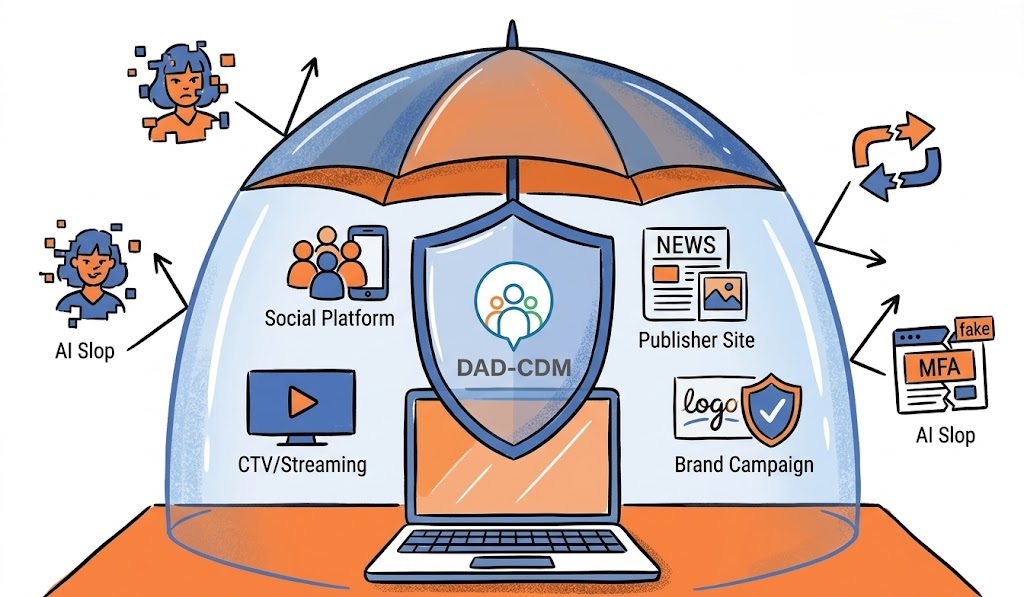
Part 1 argued that AI-generated ad fraud is a coordination problem as much as a detection problem, and that the industry needs a neutral, shared language for describing deception. Beyond the schemes it described, three developments have sharpened that case. AI slop is more widespread, and more varied, than many assumed. The verification market is consolidating. And US regulators have drawn a clear line around what kinds of industry coordination they consider unlawful.
The scale, measured
In September 2026, DoubleVerify reported detecting more than half a billion impressions of low-quality AI-generated content in the first half of the year alone. The category mix is striking. In EMEA, travel content topped the list, followed by technology, violence, sports, and vehicle disasters. Slop is not confined to fringe corners of the web; it follows attention wherever it goes.
Consumers are noticing. According to the same DoubleVerify data, 48% of UK consumers say seeing a brand advertised next to low-quality AI content would hurt their perception of that brand, and 30% say the impact would be very negative.
DoubleVerify’s own framing of the problem echoes the argument we made in Part 1. New sources emerge daily, so chasing individual pieces of content isn’t enough. Advertising revenue is also what makes cheap slop worth producing at scale. A problem that regenerates this quickly can’t be solved one platform at a time.
The picture is more varied than the headline numbers suggest. In a controlled exposure test with nearly 5,000 US and Canadian adults, Zefr, a brand suitability vendor, and Omnicom Media’s OM Media Trials found that ads placed next to AI satire, youth depictions, and creative expression lifted perceptions of a brand as “innovative” or “refreshing” more than ads next to human-created content did. Ads next to spam, sexualized imagery, and public-figure misinformation gained less in perceived quality and credibility.
Uncertainty carried a cost. In the study’s modeling, viewers who couldn’t tell whether a video was AI-generated or human-made were less favorable toward the brand next to it, on trust, perceived quality, and purchase intent. Nearly a third (32%) of viewers shown human-created videos called them AI or said they couldn’t tell, and 41% said they would feel more positive about a brand when AI content was clearly labeled. That points to distinctions a shared vocabulary needs to preserve. Whether content is synthetic, whether that is disclosed, and whether it is built to mislead are separate questions, and each can be described without anyone agreeing on what content is acceptable.
More detectors, fewer independent vendors
Detection capacity keeps growing. IAS moved its Low-Quality GenAI Avoidance tool from beta to general availability in May. It reported that ads served away from AI slop saw a 49% higher success rate across more than a billion impressions. DoubleVerify extended AI SlopStopper to social platforms in April, and Channel Factory launched its own AI slop detection product in July. That is good news for advertisers. It also means more proprietary taxonomies describing the same threats in different terms.
At the same time, ownership is consolidating. In August, Nielsen agreed to acquire DoubleVerify for approximately $2.15 billion, and DoubleVerify shareholders approved the deal in October. Closing is expected by the first quarter of 2027, subject to regulatory approvals, and DoubleVerify will continue under its own brand. That follows IAS’s acquisition by private equity firm Novacap last year. Industry observers have already asked how verification signals will be perceived when the largest vendors sit inside larger media businesses.
We take no position on those deals. But they strengthen the case for an open standard that no single vendor or owner controls. When the companies generating detection signals change hands, the format those signals travel in should stay stable, transparent, and open to everyone.
The rules are changing
Part 1 described GARM’s 2024 shutdown as a cautionary tale. Regulators have since taken the story further.
In April 2026, the Federal Trade Commission and eight states filed a complaint alleging that WPP, Publicis, and Dentsu had, since 2018, unlawfully coordinated common brand safety standards through GARM and the 4A’s Advertiser Protection Bureau. The complaint alleged this included treating sites deemed to carry “misinformation” as below the brand safety floor.
The three firms agreed to consent orders, without admitting wrongdoing. The orders bar them from agreements setting common brand safety standards or restricting advertising based on political viewpoint. In 2025, Omnicom accepted a similar order as a condition of acquiring IPG, and Havas followed in June, bringing all six of the largest holding companies under comparable orders.
These actions are contested. The FTC describes the conduct as an illegal boycott that distorted both competition and public debate. Ratings firms caught up in the probe dispute that characterization, and NewsGuard has sued the FTC over its handling of the Omnicom-IPG order. The case is not settled as a matter of public opinion, and it isn’t our place to settle it.
What is clear is the practical lesson for anyone building shared infrastructure in advertising. Coordination that dictates what content is acceptable, or that pushes participants toward uniform exclusion decisions, now carries real legal and political risk.
Why describing is different from deciding
This is the distinction DAD-CDM was designed around from the start. It is a data model, not a brand safety standard. It gives defenders a common way to describe what they observe, such as a redirect chain, a synthetic image passed off as real, or a network of sites sharing hidden infrastructure. It does not tell anyone what is true, which viewpoints are acceptable, or where to spend.
In practice, that means:
- Mechanics, not meaning. The indicators DAD-CDM captures are technical and observable, like generation method, distribution pattern, and concealed intent written into a prompt. A fraudulent redirect chain is the same object regardless of the politics of the content at the end of it.
- Shared descriptions, independent decisions. A signal shared in STIX format is information. Every organization that receives it applies its own policies, its own clients’ preferences, and its own judgment.
- Open governance. As an OASIS Open Project, DAD-CDM’s work happens in public, under an open process that any organization can join.
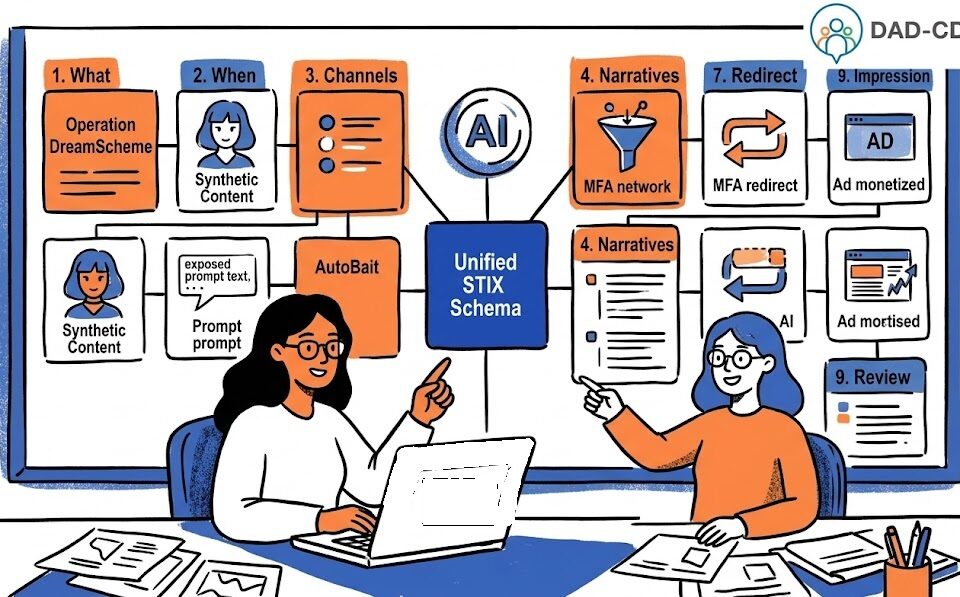
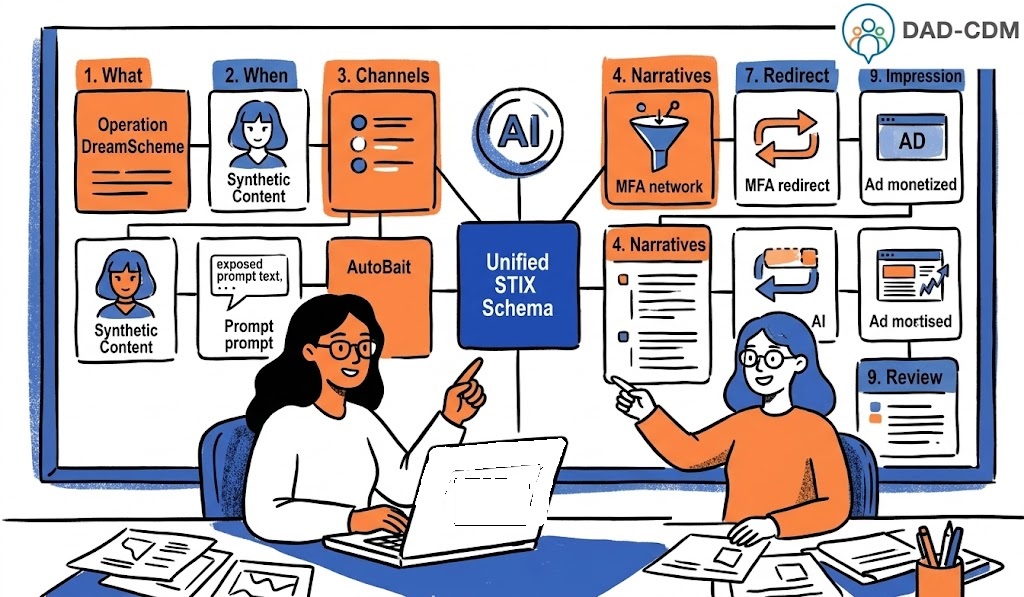
The schemes described in Part 1, DreamScheme and AutoBait, are fraud. They deceive consumers about what they’re clicking on and deceive advertisers about where their money goes. Describing that fraud consistently doesn’t require anyone to agree on contested questions about speech. It only requires agreeing on what a redirect chain is.
Where this leaves us
The threat is larger than it looked in the spring, and it’s growing in more places at once. Detection is improving, but it is also fragmenting across more tools and consolidating under fewer owners. And the industry has been told, in no uncertain terms, that shared judgments about acceptable content are off the table.
That combination points to one kind of coordination that remains both necessary and defensible: a neutral, open language for describing deception, with every participant free to decide what to do about it. That’s the work DAD-CDM exists to do, and we’d welcome more of the advertising ecosystem to the table.
About DAD-CDM: The Defending Against Deception Common Data Model is an OASIS Open Project creating open standards to capture, analyze, and exchange threat data relating to deception across sectors and borders. Learn more or contribute on GitHub.
About AdTechCares: AdTech Cares uses digital advertising infrastructure and donated media inventory to support critical public service announcements (PSAs). It connects media owners, publishers, and ad tech platforms to donate ad space and resources for societal benefit.
Would you like to explore how your organization could contribute to this effort? Contact DAD-CDM or AdTechCares.
Sources
- Advanced Television, “Data: AI slop hits 500m+ impressions in H1 2026” (Sep 14, 2026)
- Advanced Television, “Channel Factory launches AI Slop Detection” (Jul 16, 2026)
- IAS, “Cut the AI Slop: IAS Low-Quality GenAI Avoidance Is Now Live” (May 29, 2026)
- PPC Land, “IAS opens beta for tool that blocks low-quality AI content near ads” (Apr 13, 2026)
- DoubleVerify, “Introducing DV’s AI SlopStopper for Social” (Apr 16, 2026)
- DoubleVerify, “Fraud Alert! AI Slop ‘Dream Girls’ Are an Advertiser’s Nightmare” (Jun 2026)
- Zefr and OM Media Trials, “AI Slop or Not? Navigating the Risks and Opportunities of Ad Adjacency to AI-Generated Content” (May 2026)
- DoubleVerify, “DV Exclusive: Inside an AI Slop Factory” (Mar 4, 2026)
- Integral Ad Science, “IAS Announces Completion of Acquisition by Novacap” (Dec 23, 2025)
- FTC, “FTC Secures Agreement with Havas to Restore Competition in the Digital Advertising Ecosystem” (Jun 2026)
- DoubleVerify, Form 8-K on the October 29 special meeting results (Oct 29, 2026)
- Nielsen, “Nielsen to Acquire DoubleVerify” (Aug 6, 2026)
- AdExchanger, “Nielsen Is Acquiring DoubleVerify For $2.15 Billion” (Aug 7, 2026)
- Marketing Dive, “Nielsen acquires DoubleVerify to link ad verification, audience measurement” (Aug 7, 2026)
- WFA, “WFA discontinues GARM” (Aug 9, 2024)
- FTC, “FTC Takes Action to Restore Competition in the Digital Advertising Ecosystem” (Apr 2026)
- MediaPost, “FTC: Dentsu, Publicis, WPP To Discontinue ‘Brand Safety’ Standards” (Apr 15, 2026)
- PPC Land, “FTC sues WPP, Publicis, and Dentsu over brand safety collusion” (Apr 16, 2026)
- eMarketer, “FTC settles with Publicis, WPP, and Dentsu to end alleged brand safety collusion” (Apr 16, 2026)
- DAD-CDM: project site, GitHub, governance repo
- OASIS, STIX documentation